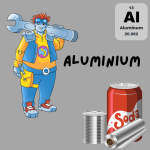
Definition
Aluminium (symbol: Al) is a lightweight, silvery-white metal that is the most abundant metal in Earth’s crust. It is the third most abundant element overall, after oxygen and silicon. Aluminium is known for its corrosion resistance, excellent conductivity, and versatility.
Where Aluminium Is Found
Aluminium is not found in its pure form in nature due to its high reactivity. Instead, it occurs in various compounds, primarily as bauxite ore, which contains aluminium oxide.
Major Bauxite-Producing Countries
Australia – The largest producer of bauxite, with vast reserves.
Guinea – Significant deposits in West Africa.
China – A major producer of bauxite and aluminium.
Brazil – Rich in bauxite reserves.
India – Notable deposits and growing production.
Aluminium is extracted from bauxite through a process called the Bayer Process, followed by electrolysis in the Hall-Héroult process to produce pure aluminium.
Uses of Aluminium
Due to its unique properties, aluminium has a wide range of applications across industries
1. Transport
Aerospace: Aircraft bodies due to its lightweight and strength.
Automotive: Car parts like wheels, engine blocks, and body panels.
Railways: Lightweight train components.
2. Construction
Windows and doors.
Roofing materials.
Structural components like beams and frames.
3. Packaging
Cans: For soft drinks and food, as it is lightweight and recyclable.
Foil: Used for wrapping food and preserving freshness.
4. Electrical Applications
Power lines and cables due to its excellent conductivity and lower weight compared to copper.
5. Consumer Goods
Electronics, such as laptops and smartphones.
Cooking utensils like pots, pans, and kettles.
6. Renewable Energy
Used in solar panels and wind turbine components for its durability and corrosion resistance.
Aluminium is prized for its recyclability, as it can be reused indefinitely without losing its quality, making it a cornerstone of the circular economy.
.