Welcome to our
Project/IDL Topic Hub
Project based learning information
Topic and Ecosystem Resources
New resources constantly arriving
Page Contents
Project Based Learning Theory
Special days special topics
Eco Systems
Topics
Project-Based Learning (PBL) for Sustainability and the Circular Economy: Philosophy
.Project-based learning (PBL) is an educational approach that prioritises hands-on, real-world learning experiences. For high school learners, PBL offers an invaluable opportunity to explore sustainability and the circular economy in a meaningful and engaging way. The philosophy underpinning this approach aligns with fostering critical thinking, collaboration, and practical problem-solving skills, essential for addressing 21st-century global challenges.
Learner-Centred and Purposeful
At its core, PBL for sustainability and the circular economy empowers learners to take ownership of their education. Rather than passively absorbing information, learners are actively involved in investigating real-world problems, such as waste reduction, renewable energy, or sustainable food systems. These projects are grounded in authentic contexts, ensuring that the work feels relevant to their lives and the wider community.
Interdisciplinary Exploration
Sustainability and the circular economy are inherently interdisciplinary, encompassing science, geography, economics, and design technology. A PBL approach encourages learners to draw connections between these fields, developing a holistic understanding of complex systems. For instance, a project might involve designing a product using sustainable materials, calculating its environmental impact, and creating a marketing plan to promote its benefits.
Real-World Application
The philosophy of PBL emphasises real-world application. Learners collaborate on projects that simulate professional practices, such as conducting waste audits, designing eco-parks, or consulting with local businesses on sustainable practices. This not only bridges the gap between classroom learning and the outside world but also instils a sense of purpose and responsibility in learners.
Collaboration and Skills Development
PBL mirrors the collaborative nature of addressing sustainability challenges. All aged school learners work in teams, honing skills such as communication, leadership, and adaptability. These experiences prepare them for future roles as global citizens, capable of working collaboratively to solve complex problems.
Reflection and Growth
An essential aspect of PBL is reflection. Learners are encouraged to evaluate their progress, the effectiveness of their solutions, and their impact on the environment and society. This reflective practice reinforces the importance of adaptability and resilience in tackling sustainability challenges.
Values-Driven Education
PBL for sustainability and the circular economy aligns with values-driven education, fostering an ethos of stewardship and care for the planet. By engaging learners with the principles of reduce, reuse, recycle, and redesign, it cultivates a mindset of responsibility and innovation.
By adopting PBL, educators can inspire high school learners to view sustainability and the circular economy not as abstract concepts but as tangible, achievable goals. This philosophy encourages learners to envision themselves as changemakers who can contribute to a more sustainable future.
David H. Jonassen (1947–2012)
- Philosophy: Jonassen, was an American instructional designer, who championed the use of technology and problem-based learning.
- Key Ideas: Problem-solving and critical thinking are central to effective learning. He advocated using real-world problems and digital tools in projects.
- Influence: His theories contribute to the technology-enhanced aspects of PBL.
Seymour Papert (1928–2016)
- Philosophy: Papert, a South African-born mathematician and computer scientist, developed constructionism, a learning theory closely related to PBL.
- Key Ideas: Learners construct knowledge through active creation, particularly when using technology. Papert advocated for project-based approaches to integrate creativity and problem-solving.
- Influence: His work supports the integration of digital tools and coding in PBL.
Howard Gardner
(b. 1943)
- Philosophy: Gardner, an American developmental psychologist, is known for his theory of multiple intelligences.
- Key Ideas: PBL can cater to diverse intelligences (e.g., linguistic, logical-mathematical, spatial, interpersonal) by providing varied roles and tasks within projects.
- Influence: His theory emphasises the need to design projects that address different learning styles and strengths.
John Dewey
(1859–1952)
- Philosophy: Dewey, an American philosopher and educator, is often considered the father of experiential education. His belief in "learning by doing" laid the groundwork for PBL.
- Key Ideas: Education should be rooted in real-world experiences, promoting inquiry, problem-solving, and reflection. He argued that learning occurs best when it is connected to meaningful, practical experiences.
- Influence: Dewey’s ideas influenced progressive education and emphasised the role of the learner as an active participant in the learning process.
William Kilpatrick (1871–1965)
- Philosophy: Kilpatrick, an American educator and a contemporary of Dewey, formalised the "project method."
- Key Ideas: Projects should be purposeful, learner-directed, and connected to real-world problems. He defined projects as whole-hearted, goal-oriented activities.
- Influence: His work is foundational to the structured implementation of PBL.
Ron Berger
- Philosophy: Berger, an American educator, focuses on craftsmanship, authenticity, and quality in project-based work.
- Key Ideas: PBL should result in meaningful, high-quality outcomes. His book An Ethic of Excellence emphasises creating work that is authentic and of value to the community.
- Influence: Berger’s work inspires educators to ensure PBL connects learners with real-world impact.
Special Events Days and Weeks

Find our general resources by clicking the button below
Climate Mental Health
We advocate Earth Stewards not Climate Warriors.
Please find our ever developing pack here .
Earth Day
Being Earth Stewards is our main focus. Our Earth day resources will support you with this.

EcoSystem Resources
Agriculture and Aquaculture entwined
with Ecosystems
Agriculture/ Aquaculture and ecosystems are deeply intertwined, and sustainable agricultural practices are essential to maintaining ecosystem health while ensuring long-term food security.
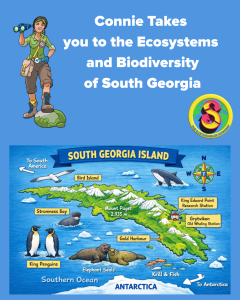
South Georgia Biodiversity and Eco system
Topics
From Farm to Fork to Farm
Primary through to High School
See also Food and Agriculture strand of our curriculum
Under the sea
See also Water conservation strand of our curriculum. See also our pack by Scottish Shellfish