

Plasto The Earth Steward
of Polymers
Helping you understand the Circularity of our Plastic Resources
and Bio Plastics
Plasto is the Earth Steward for Polymers

Plastic and polymers often get a bad reputation, but they are valuable resources that we need to manage wisely. Once oil and gas are extracted from the ground, they cannot be returned. Given that these resources are finite and will eventually run out, it’s crucial to make the most of them. We also want to avoid producing plastic from new, virgin oil. Therefore, it is essential to keep plastic in circulation for as long as possible.
Plastic has the advantage of being lightweight, making it easier and more efficient to transport. Moreover, recycling plastic is straightforward and requires minimal energy and water, making it an environmentally friendly option. By focusing on recycling and reusing plastic, we can conserve resources and reduce our reliance on new materials.
Plastic Biosphere Buzz Talk
5-11 years
Image of Resource
Biosphere Buzz Talk discussion questions suitable for 5-11 years
More resources & more to come
Plastic Paradox
How and why we need plastics
While plastics pose significant environmental challenges, their versatility, economic importance, and utility in numerous sectors make them an invaluable resource. By managing plastic responsibly through improved recycling, reduction of single-use plastics, and development of sustainable alternatives, we can harness their benefits while minimizing their environmental footprint.
Circular Plastics and Polymers
Find out more plus we have provided links to a supportive You Tube
to help understand Polymer and
Plastic Recycling.
Visit our circular plastics
and polymers page below
Become A Circular Economy School
... with a focus on Recycling Plastics from Cradle to Cradle.
By embracing the circular economy with a focus on plastics, schools can play a crucial role in fostering a sustainable future.
Teaching students about the value of plastics, proper waste management, and the importance of recycling prepares them to be responsible stewards of the planet.
Additionally, schools can be powerful advocates for policy changes that support robust recycling systems, ensuring a more sustainable use of plastics and other materials.
Notes for Teachers on Becoming a Circular Economy School with a Focus on Plastics
Introduction to Circular Economy
- Definition: The circular economy is an economic system aimed at eliminating waste and the continual use of resources. It contrasts with a linear economy, which follows a ‘take-make-dispose’ model.
- Principles: Design out waste and pollution, keep products and materials in use, and regenerate natural systems.
Importance of Teaching Circular Economy
- Sustainability: Prepares learners to think critically about resource use and sustainability.
- Environmental Impact: Reduces waste, conserves resources, and mitigates climate change.
- Economic Benefits: Promotes innovation and job creation in recycling and up-cycling industries.
Transitioning from a Linear to a Circular Economy in Schools
Awareness and Education:
- Integrate circular economy principles into the curriculum.
- Conduct workshops and seminars on sustainability and resource management.
- Use case studies and real-life examples to illustrate circular practices.
Resource Management:
- Audit current resource usage and waste production.
- Set up systems for reducing, reusing, and recycling materials.
Practical Implementation:
- Establish recycling programs for paper, card, and plastics.
- Create composting systems for organic waste.
- Promote the use of digital tools to minimise paper usage.
Community Involvement:
- Engage students, staff, and parents in sustainability initiatives.
- Partner with local businesses and organisations for resources and support.
Focus on Plastics
The Value of Plastics
- Versatility: Plastics are used in a wide range of products due to their durability, lightweight, and versatility.
- Economic Importance: Plastics contribute significantly to the economy, supporting various industries.
- Environmental Impact: Proper management is essential to prevent environmental harm. Mismanaged plastics can lead to pollution and wildlife harm.
Importance of Managing Plastic Waste
- Resource Conservation: Reducing plastic waste conserves raw materials and reduces the need for new plastic production.
- Pollution Reduction: Proper plastic waste management prevents pollution in oceans and landfills.
- Sustainable Use: Encourages the sustainable use of plastics by promoting recycling and reuse.
Benefits of a Circular Economy for Plastics
- Reduced Emissions: Recycling plastics reduces greenhouse gas emissions compared to producing new plastics from raw materials.
- Energy Savings: Recycling uses less energy than the production of new plastic products.
- Waste Reduction: Minimises plastic waste in landfills and the environment.
Classroom Activities
Waste Audit Project:
- Have learners to design & conduct a waste audit of the school.
- Analyse the types and amounts of plastic waste generated.
- Develop a plan to reduce plastic waste.
Recycling Crafts:
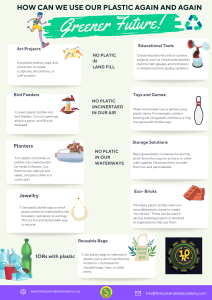
- Organise workshops to create new items from recyclable plastics.
- Showcase learner creations in a ‘Recycled Art’ exhibition.
Eco-Friendly Challenges:
- Initiate challenges like ‘Zero Waste Week’ or ‘Plastic-Free Month’.
- Encourage learners to document their efforts and results.
Guest Speakers and Field Trips:
- Invite experts in sustainability and circular economy to speak at the school.
- Arrange visits to recycling plants and eco-friendly businesses.
Lobbying Policy Makers for Plastic Recycling Systems
Understanding Policy:
- Educate learners and staff on current recycling policies and the importance of policy changes.
- Research successful recycling programs in other regions.
Creating a Proposal:
- Develop a comprehensive proposal highlighting the need for better plastic recycling systems.
- Include data from school waste audits and potential environmental and economic benefits.
Engagement and Advocacy:
- Organise letter-writing campaigns to local and national policymakers.
- Set up meetings with local government officials to present the proposal.
- Use social media to raise awareness and garner support from the community.
Collaborating with Other Schools:
- Partner with other schools to create a unified voice for change.
- Share resources and strategies for effective advocacy.