Linking The Sustainables Academy to The United Nations Rights and Respecting Schools Award.
The Sustainables Academy believes that it is the Right of the Child to live on a clean and health planet, in a safe and healthy environment . This is where educators can link Sustainability and The Circular Economy to RRS and emphasise the fact that we are all RESPONSIBLE.
What Does It Mean?
The United Nations Convention on the Rights of the Child (CRC) primarily focuses on ensuring the rights and well-being of children. While it may not explicitly address sustainability and the circular economy, several principles within the CRC can be connected to these concepts. Here are a few examples:
Article 24 - Right to Health:
The right to the highest attainable standard of health for children can be linked to sustainability by emphasising access to clean water, nutritious food, and a healthy environment. Circular economy principles can contribute to reducing environmental pollution and promoting overall well-being.
Article 29 - Goals of Education:
Education is a key component of sustainable development. Teaching children about the principles of sustainability and the circular economy can help instil values that promote responsible consumption, waste reduction, and environmental stewardship.
Paragraph 1 (d):
This paragraph emphasises the preparation of the child for responsible life in a free society, in the spirit of understanding, peace, tolerance, equality of sexes, and friendship among all peoples. Environmental education can be seen as part of preparing children for a responsible life, instilling values related to the environment, and promoting a sense of responsibility toward nature.
Article 6 - Right to Life, Survival, and Development:
This fundamental right can be connected to sustainability by emphasising the importance of creating a world where children can not only survive but also thrive in a balanced and sustainable environment.
Article 12 - Respect for the Views of the Child:
In the context of sustainability and the circular economy, involving children in decision-making processes can be valuable. Their perspectives and ideas can contribute to innovative and sustainable solutions.
The principles within the Rights and Respecting Schools UN Rights of the Child can be applied to promote sustainable practices and a circular economy that ensures a better future for all children.
Resources
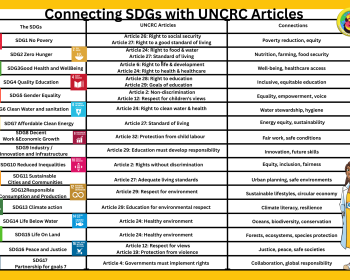
Our Matrix UNCRC / Sustainability
Visit Matrix for UN Rights of the Child and Sustainability
From 2014 – Video clip describing young people’s rights under international human rights law (the Convention on the Rights of the Child or CRC for short) in friendly language.
“We All Have Rights” explains child rights to children aged 3 to 6. This project draws on UNICEF research about introducing the United Nations Convention on the Rights of the Child (CRC) to your little ones. Follow Viz, Leepa and their pet Zooko on their treasure hunt for child rights!
‘We’ve all got rights’ is a fantastic song and animation by children and staff from Crosby High School, a Unicef UK Rights Respecting School in Liverpool. Find out more about how your school can promote and uphold children’s rights with the Rights Respecting Schools Award at www.unicef.org.uk/rrsa